


Yagna
Living for Others

We humans live in the material world to serve and uplift our fellow beings. When we do this, we experience fulfilment, because the key to our own fulfilment lies in serving our fellow beings and not in trying to satisfy ourselves. All beings are considered fellow beings, not just humans.
It is part of the Divine Plan that we ensure the satisfaction of others by trying to fulfil their needs and thereby attain satisfaction ourselves. According to the original Plan, we incarnate on the planet at regular intervals to uplift our fellow beings, and in this way we earn our right to exist here. Eastern scriptures say that with every breath, humans are to fulfil their fellow living beings, thus fulfilling all the atoms in the tissues of their bodies. This service to our fellow beings is called ‘Yagna’—an action through which we fulfil minerals, plants, animals, and fellow humans.
The Vedic term ‘Yagna’ is imperfectly translated as ‘sacrifice’, for it goes far beyond that. In the highest wisdom, Yagna refers to the principle of action that emerges as an eternal pattern from the eternal, indestructible, nameless, and formless One. Creative consciousness permeates and establishes everything through Yagna, the wheel of sacrifice. Sacrifice means not living for oneself, but for others — a selfless life instead of a selfish one.
The Wheel of Sacrifice
Creation proceeds as Yagna; it does not happen for the creator. The cosmic, solar, and planetary devas, the animals, plants, and minerals all exist for others, not for themselves, and humans should live this way too. “Work as sacrifice is divine karma, and work for oneself is individual karma,” says the Bhagavad Gita. In the third book, the ‘Book of Action’, the Lord says that everything takes place due to the turning of the invisible wheel called Yagna, sacrifice. “Sacrificial activity is a wheel that turns within and outside of creation. Creation is woven from it. All the interlinked actions of cause and effect in this creation are structured like a wheel: there is no beginning and no end, only rotation…”
The cyclical movement of the planet causes rain, and in the process, water moves from the invisible to the visible state and from the visible to the invisible state. Through the germination and reproductive capacity of water, plants grow and food is produced, which is also refreshed by rain. Animals and humans consume plants as food and also feed partly on animals. Through the seasonal upward and downward movements, nature provides nourishment for living beings. Through the movement of the invisible wheel, the Lord himself performs the sacrifice for the sake of living beings, and we should follow this Yagna: “Follow the course of this wheel. Do what it does, then you too will have performed Yagna. Those who do not cooperate will lose themselves in sensual enjoyment.”
Liberation through Giving
When we live and work for ourselves, we create waves in creation. Our motive lies within ourselves, and our actions trigger a series of chain reactions that correspond to the motive. The effect returns to us. The result is a self-created limitation that restricts and binds us as our individual karma. Actions for others do not originate from us; the motive does not lie within us. Selfless activity does not bind but enables the expansion of consciousness.
Through giving we are liberated, and through receiving we are bound. We can receive, provided we also give. If we give more than we receive, we are on the path of ascent. But if we receive more than we give, we are on the path of descent. That is why those who know continue to give. Society thinks they are serving and sacrificing, but they know that it is neither service nor sacrifice, but a repayment of debts, a clearing of karma. Service is done in gratitude to everyone who receives from us. If they did not receive, how could we liberate ourselves? That is why the Eastern scriptures say that the giver should think that the receiver is divine. If we think we are serving, then the soul of service is lost.
With love as the foundation, sacrifice can be easily performed. When we have a loving attitude toward someone, there is no painful feeling in giving. When sacrifice and renouncement are lived daily, as in a partnership and with our own children, we do not feel either, because it has become natural for us to behave in this way.
It is important not to lose the joy of sharing. If we feel pain when making sacrifices, this is a sign that we should wait and not push ourselves. We feel pain because we are attached. Feeling something when giving is unnatural. It arises when we do not have enough love. In the East, there is a saying: “Do not give when you feel that you are giving. Do not serve when you feel that you are serving. Do not sacrifice when you feel that you are sacrificing.” Feelings form a smoky part of our actions. Feelings generally concern ourselves or others. The more we live in feelings, the more smoke is created and the less we can see.
There is a way of acting without such feelings that brings us the Light of the Soul and allows us to see the direction of our actions without smoke. An initiate acts in a “causeless” state for the sake of the action. Gradually, his causal body dissolves and his consciousness merges into the consciousness of the soul. The initiate is then outside the consequences of his actions.
When we ascend to the Buddhic plane, into the Light of the Soul, giving is a joy. By seeing the One, we realize that there is no such thing as service and sacrifice. Our likes and dislikes, our views and motives give way to His plan. Our own personality is transcended. However, it is not easy to transcend and sacrifice one's own personality. We cannot transcend our personality or ego overnight, yet only in this way can the soul be born completely and shine forth. It requires us to put aside our own opinions, likes and dislikes, and use our resources and abilities for the benefit of the life around us.
In order to experience the One Consciousness and allow it to work through us, the limitations or boundaries of our personality on the various levels are to be dissolved. This is the case in the third initiation, where the candidates say, “Everything for You, we sacrifice ourselves with joy, use me as You wish.” They remain silent, even in the face of worldly attacks. Their head is symbolically cut off, their tongue pulled out, and their body thrown to the vultures. They are willing to sacrifice their personality for the Plan. This means that they have dedicated themselves to service, even to the point of self-sacrifice, in order to gain the Lord's favour and merge with Him. Thus they come to the fourth initiation.
Purusha and Self-Surrender
Stories and teachings about this have a direct effect on awakening the soul. Our consciousness immediately senses that what is said is true. There are thousands of ways to reach the truth and no single way. The path we choose corresponds to the quality of our soul.
We are all created in the image and likeness of the original form, which is called the Cosmic Person. He is the origin, and we are copies of this prototype; all human forms were formed after him. It is the essence of all wisdom teachings that we, as ‘I AM’, are a copy of the first ‘I AM’, which is referred to in the Vedas as ‘THAT’ or the Cosmic Person, and we ultimately merge our identity into ‘THAT’.
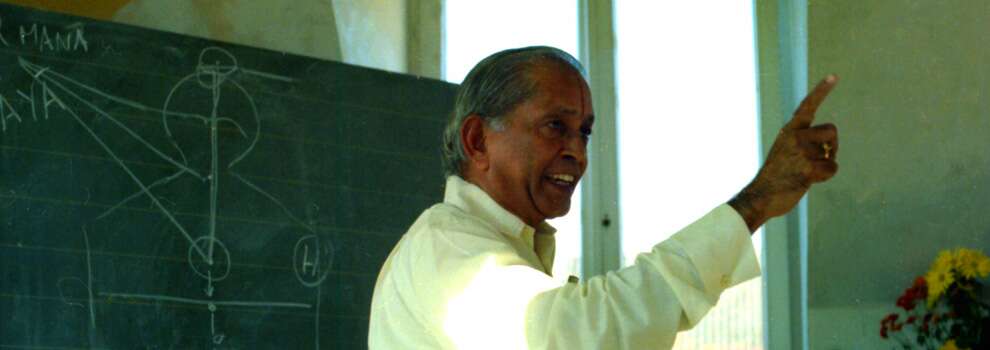
The cosmic person is called Purusha in Sanskrit; in essence, we can refer to it as the cosmic Christ. As a step on our path to the realization “THAT AM I,” it is recommended to regularly chant the Purusha hymn from the Rig Veda. In 1982 and 1983 in Geneva, Master E.K. gave profound commentaries on this hymn of the sacrifice of the Cosmic Person. The devas of the cosmic plane performed a sacrifice with Purusha called Sarvahuta Yagna, the all-encompassing sacrifice or Sacrifice of Man. They brought the Cosmic Man out of the cosmic egg, tied Him to a vertical pole – the axis of space – and crucified Him in space, fastened to the four-armed cross. They sacrificed Him like an animal to prepare the creation with its seven planes and to fill the planes with His essence. Through this great sacrifice, the entire creation and the living beings that inhabit it came into existence. This form of sacrifice remains valid as long as creation lasts. This is the original idea of crucifixion.
The path of self-sacrifice is the most difficult path. It has rarely been demonstrated to such an extent and voluntarily as by Jesus, the Christ, in order to bring about an ascension of humanity, so that the law of Love, the light of Wisdom, and the power of Divine Will may be better understood and accepted by humanity. We can visualize the Cosmic Man in our own being and make sacrifices to unite with him.
Sources used: K.P. Kumar: Hercules. Dhanishta, India. Var. seminar notes. E. Krishnamacharya: Lessons on Purusha Sooktam. Kulapathi Book Trust, India (www.aquariusbookhouse.com)